


 English
 русский
 Español
 Deutsch
 عربى
 中文简体

Content
A size 7 ball weighs 22 ounces and measures 29.5 inches around. Hand one to a 10-year-old and the shot usually collapses into a two-handed push from the chest, because the fingers cannot spread far enough across the seams to control the release. The ball is the problem, not the player.
For nearly every 10-year-old, the correct ball is a size 5: 27.5 inches (70 cm) around and roughly 17 ounces (480 to 500 g). That is the standard youth size used from about age 9 to 11 and written into most grade 3 to 6 league rules.
Two exceptions are worth planning for. A small 10-year-old with a hand span under 6.5 inches may still be better served by a size 4, and a competitive club team may already be introducing a size 6. Both cases are covered below, along with the checks that confirm the fit in under a minute.
Size 5 in plain numbers: 27.5 inches around, 17 ounces
A size 5 basketball is 27.5 inches in circumference and about 17 ounces in weight, which makes it the standard ball for players aged 9 to 11.
The size number describes circumference, not diameter, and that is where most parents misjudge a ball in the shop. A size 5 measures 8.75 inches across. The adult men's size 7 measures 9.39 inches across. The gap in the hand is roughly two-thirds of an inch, and that margin is exactly what a 10-year-old needs to get a fingertip grip and rotate the ball on release.
Definition: basketball sizing runs 3, 4, 5, 6 and 7, and every number refers to circumference in inches. Size 5 equals 27.5 inches around and about 17 ounces, the official youth specification for ages 9 to 11.
| Size | Circumference | Weight | Typical age | Standard use |
| 3 | 22.5 in / 57 cm | 10 to 11 oz | 4 to 6 | First ball, foam and mini formats |
| 4 | 25.5 in / 65 cm | About 14 oz | 5 to 8 | Youth rec, smaller 9 and 10 year olds |
| 5 | 27.5 in / 70 cm | About 17 oz | 9 to 11 | Standard youth ball, grades 3 to 6 |
| 6 | 28.5 in / 72 cm | About 20 oz | 11 to 13 | Middle school, official women's ball |
| 7 | 29.5 in / 75 cm | About 22 oz | 14 and up | Official men's ball, high school and above |
Age charts are a starting point, not a rule. A 10-year-old who turns 11 mid-season and plays club ball will often be handed a size 6. A 10-year-old who is small for the school year and measures a hand span near 6 inches plays better on a size 4 at 25.5 inches. Hand size and control decide; the birthday only narrows the range. A full breakdown of the size 5 specification and its league usage is useful if you are buying for a whole team rather than one child.
What one size too big actually changes
Moving a 10-year-old from a size 5 to a size 7 adds 0.64 inches of diameter and five ounces of weight, roughly 29 percent more mass, and that is enough to break the shooting release, slow the dribble and force a two-handed push.
A typical 10-year-old has a hand span of about 6.5 to 7 inches. To control a ball one-handed, the fingers need to reach across the seams, so the ball diameter has to sit close to hand span. At 8.75 inches a size 5 is still slightly wider than the hand, but it can be gripped, rotated and released with backspin. At 9.39 inches a size 7 cannot, so the player improvises.
Size 5: 27.5 in, 17 oz
- One-hand release with backspin stays possible
- Dribble stays below waist height under pressure
- Free throws from 12 to 15 feet reach the rim without a heave
Size 7: 29.5 in, 22 oz
- Release drifts to two hands and loses rotation
- Dribble bounces higher and slows the crossover
- Range collapses and the elbow slides under the ball
Coaches see the same pattern every season: a child who shoots cleanly with a size 5 starts pushing the ball from the hip within a week of being handed an adult ball.
Weight matters as much as circumference. Five extra ounces in the shooting hand is a real load for a 10-year-old, and the usual compensation is a lower release point and a shoulder-driven push. If a player suddenly loses range, check the ball before touching the shooting form.
Four tests that tell you the ball is right
The ball fits when the player can grip it one-handed at chest height and shoot with a one-hand release without it slipping.
-
Grip and hold
Ask the player to pick the ball up with one hand, fingers spread, elbow bent at 90 degrees. If it rolls out or needs a second hand to steady it, the ball is too large.
-
Dribble control
Twenty dribbles at waist height, eyes up, alternating hands. A ball that is too big bounces above the waist and forces the player to look down to recover it.
-
Shooting release
Ten shots from 12 to 15 feet. Count how many leave the hand with one hand and clean backspin. Three or fewer out of ten points to a ball that is too heavy or too wide.
-
Measure and weigh
Wrap a tape around the seam line at the widest point and check the reading against 27.5 inches. Then weigh it: a size 5 should land between 470 and 500 grams, about 17 ounces.
Weight and circumference are the two things a label cannot fake for long. A ball that measures 25.5 inches and weighs 400 grams is a size 4 whatever the box says, so check both before a season starts rather than after the first month of practice.
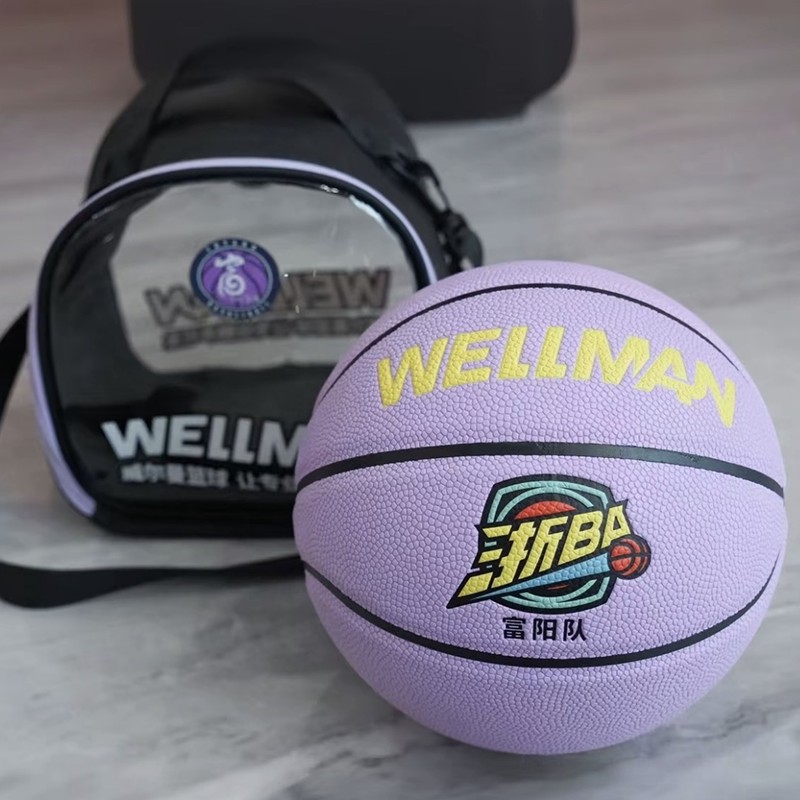 Size 4 Kids' Moisture-Absorbing PU BasketballA 25.5-inch Size 4 ball for young beginners, with soft moisture-absorbing PU and a carry bag for daily indoor and outdoor practice.View Product →
Rec league, club and school: when a 10-year-old moves up
Recreational leagues keep 10-year-olds on a size 5, while competitive clubs and middle-school programs generally move players to a size 6 at 11 or 12, and a minority move a strong 10-year-old up early.
- Boys: size 5 from 9 to 11, size 6 from 11 to 13, size 7 from 14 upward.
- Girls: size 5 from 9 to 11, size 6 from 11 upward, which remains the official women's ball through adult play.
- School programs: order by grade rather than age, because a mixed class of 9 and 11 year olds all fit a size 5.
- Tournament play: read the rulebook before the first game, since a size 6 in a size 5 division creates an avoidable problem.
Practical rule for a coach: keep the size 5 for skill work even after a player moves up. A 10-year-old can play games with a size 6 and still do ball handling and form shooting with a size 5, and the smaller ball speeds up correction of a two-handed release.
Cover, bladder and weight: what a size 5 should be made of
For a 10-year-old, a moisture-absorbing PU cover in size 5 gives better grip than a rubber ball, holds its shape through a school season and is easier on the hands during daily practice.
- Cover: rubber is cheap and survives concrete, but it is slippery on indoor courts and hard on young fingers; PU grips better and absorbs sweat; microfiber sits at competition level.
- Bladder: butyl holds air for weeks, latex feels softer but needs topping up, and synthetic rubber in budget balls loses pressure fastest.
- Panels: 8-panel is the standard construction, while 16-panel and wave designs change the seam feel and how the ball sits in a small hand.
- Weight tolerance: ask for the per-ball weight spread on a bulk order, because a carton ranging from 450 to 540 grams is not a matched set.
A size 5 youth ball with a soft PU cover and a consistent 480 to 500 gram weight is the practical choice for a 10-year-old playing three or four times a week.
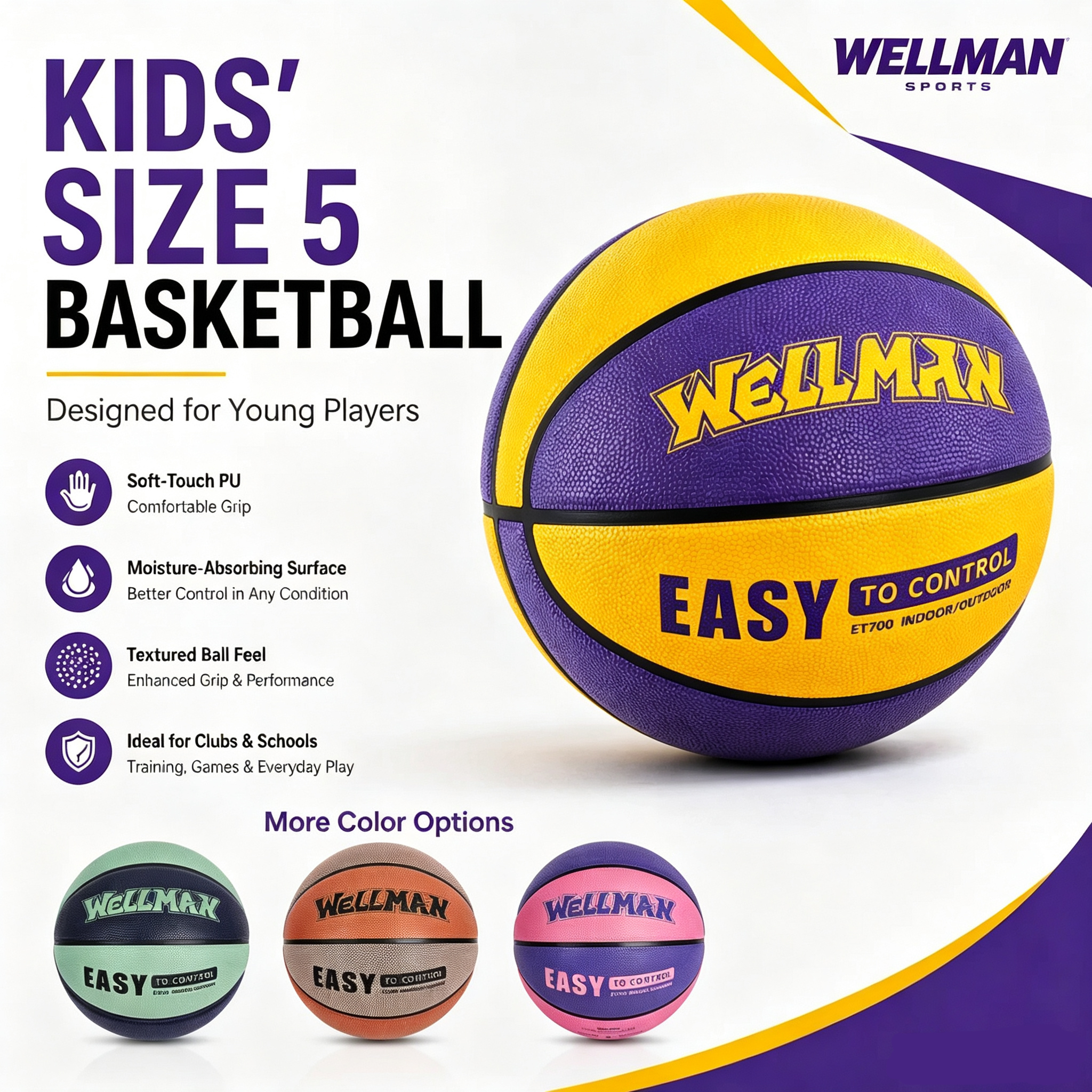 WELLMAN Size 5 Hygroscopic PU Training BasketballA 67–69 cm Size 5 ball with moisture-wicking PU and 470–510 g weight, suited to teen and adult indoor or outdoor training.View Product →
Indoor practice in a flat or a shared hall needs a quieter ball. Foam and noise-reduced constructions keep the bounce controlled without changing the 27.5 inch size, which matters when the same player trains at home and at school.
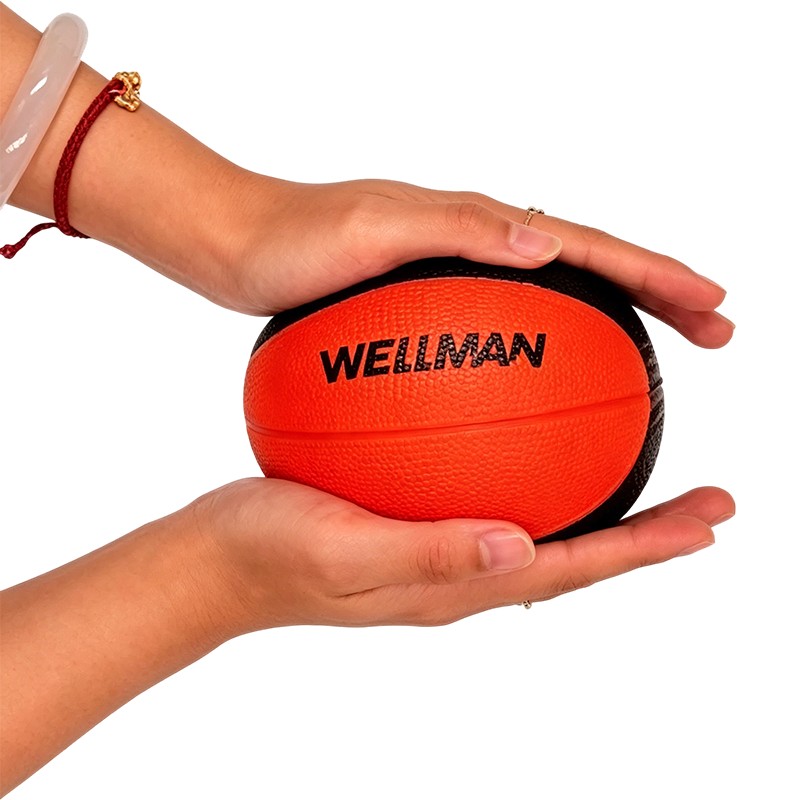 Noise-Free Foam Basketball for Indoor Kids TrainingA lightweight 37 cm PU foam ball that keeps indoor dribble practice quiet and soft, with custom children’s patterns available.View Product →
Two numbers carry most of the quality: 27.5 inches and 470 to 500 grams. A ball that hits both plays the same in October and February. A ball that drifts heavier as the season goes on usually has a bladder problem, not a cover problem.
Checklist before you buy
Buy one correctly sized ball and a second identical one rather than a bigger one, because at 10 repetition with the same ball teaches more than variety.
- Confirm 27.5 inches of circumference, about 70 cm, before anything else.
- Weigh the ball: 470 to 500 grams, roughly 17 ounces.
- Inflate to 7.5 to 8.5 psi and recheck the circumference after 24 hours.
- Match the cover to the surface: PU for indoor courts, a tougher rubber or composite for outdoor concrete.
- Buy two identical balls so a lost or flat ball does not change the feel mid-season.
- For a team order, specify size 5 for grades 4 to 6 and size 6 for grades 7 and 8.
Program buyers ordering for a school or club usually need the same size, weight and cover across a full carton, plus a printed logo. Custom size 5 production with a set weight tolerance and team printing runs through the OEM and ODM service, and it is worth asking for a sample ball to weigh before the full order ships.
One last check: inflate a new ball to the low end of the range, 7.5 psi, and let the player shoot with it. A ball at 8.5 psi feels harder and slightly larger in a small hand, and the low end is usually where a 10-year-old shoots most accurately.
Frequently asked questions
Is a size 5 basketball the same as a 27.5 inch ball?
Yes. Size 5 and 27.5 inches describe the same ball, measured around the circumference at the widest point. The 17 ounce weight is the other half of the specification.
Should a 10-year-old girl use a different ball from a boy?
No. At 10, boys and girls use the same size 5 ball. Girls' leagues typically move to a size 6 at 11 or 12, and that size remains the official women's ball into adult play, while boys move to a size 7 at 13 or 14.
My 10-year-old is tall with large hands. Should we move up to a size 6?
Only if the player can palm a size 6 and shoot it one-handed from 15 feet. Height alone is not the signal; hand span and control are. A tall 10-year-old on a ball they cannot grip will still push it with two hands.
How much should a size 5 basketball weigh?
Between 470 and 500 grams, about 17 ounces. A ball under 450 grams is usually a mislabeled size 4, and one above 520 grams has either taken on moisture or been built to a heavier tolerance.