


 English
 русский
 Español
 Deutsch
 عربى
 中文简体

Content
- Why Indoor Basketballs Are Built Differently
- The Cover Materials That Decide Feel and Price
- Sizes and Weights Buyers Should Specify
- Grip, Dust and Moisture: What Actually Fails in a Gym
- Indoor and Outdoor Basketball Compared
- A Procurement Checklist for Schools, Clubs and Distributors
- Care Routines That Extend Gym Life
- Frequently Asked Questions
Indoor basketball is a category defined by grip and consistency, not abrasion resistance. A ball built for hardwood uses a softer, tackier cover, a bladder tuned for predictable bounce, and tighter production tolerances, because the floor under it never grinds the cover away the way concrete does.
A polished gym floor is clean, smooth and unforgiving. Every raised seam, every slick patch and every hard bounce shows up immediately, which is why the ball that survives a season on asphalt is rarely the ball a coach wants for a Friday night game. The two products are solving different problems, and the specification sheets prove it.
Why Indoor Basketballs Are Built Differently
Indoor basketballs are engineered around grip and bounce consistency, while outdoor basketballs are engineered around abrasion resistance. That single difference drives the cover compound, the cover thickness, the bladder type and, ultimately, the price you pay per ball.
On a hardwood or synthetic gym floor the cover is not being sanded down. The ball is handled: caught, dribbled, squeezed and passed. Manufacturers therefore put the budget into tack, softness and seam feel, and accept compounds that would wear through quickly on concrete. Outdoor balls go the other way, with harder covers and deeper pebbling that survive grit and rough surfaces but feel slick and heavy on a gym floor.
A gym floor does not wear a ball out. Hands, dust and air pressure do. Most indoor failures appear as surface glaze, slick patches or a soft bladder long before the cover ever splits.
- Softer cover compounds that grip before the break-in period is finished.
- Tighter weight tolerance, because a gym ball often becomes the reference product for a league or a school district.
- Bladder choice balanced between air retention and soft touch, since indoor balls are inflated to a narrow range and expected to hold it for weeks.
The Cover Materials That Decide Feel and Price
Full-grain leather delivers the best feel, microfiber leather is the practical competition standard, and composite PU covers most training volume. Rubber is an outdoor material and rarely belongs on a gym ball unless the budget is the only constraint.
| Cover type | Grip and feel | Typical use | Trade-off |
| Full-grain leather | Deepest tack, breaks in and molds to the hand | Elite competition, showcase games | Highest cost, needs consistent care |
| Microfiber leather | Close to leather, very consistent from ball to ball | Club and school competition | Mid to high cost per unit |
| Moisture-absorbing PU | Stays tacky when hands are damp | Humid gyms, tournament weekends | Needs regular cleaning to keep the surface open |
| Composite PU | Firm, durable, adequate grip | Daily training, PE classes, drills | Less soft touch than leather |
| Rubber | Hard and slippery on clean floors | Outdoor courts only | Poor indoor grip, harsh feel |
The bars above show relative cost positioning rather than exact prices, but the order holds across most factory quotes. For a closer look at how the two most common indoor covers behave over a season, this comparison of PU and microfiber basketball leather walks through grip, wear and maintenance.
 Microfiber Leather Competition Grade Size 7 BasketballCompetition-grade size 7 microfiber leather basketball with customizable logo, made for professional matches and intensive training on indoor hardwood or outdoor cement courts.View Product →
Sizes and Weights Buyers Should Specify
Basketball sizes run from 3 to 7 wherever the game is played; what changes indoors is how strictly the weight should be written into the purchase order. A size 7 ball at 600 g and a size 7 ball at 650 g do not feel like the same product to a shooter, and a mixed batch will be noticed in the first practice session.
| Size | Circumference | Weight range | Typical user |
| 3 | 22.5 in / 57 cm | 300-340 g | Ages 5 to 7, basic ball handling |
| 4 | 25.5 in / 65 cm | 350-400 g | Ages 7 to 9, junior programs |
| 5 | 27.5 in / 69 cm | 470-500 g | Ages 9 to 11, youth leagues |
| 6 | 28.5 in / 72 cm | 510-567 g | Women's competition, ages 12 and up |
| 7 | 29.5 in / 75 cm | 600-650 g | Men's competition, ages 14 and up |
Write the weight band into the order, not just the size. A tolerance of 10 to 15 g inside one shipment is realistic for a well-controlled production line, and it is the cheapest quality upgrade most buyers never ask for.
Grip, Dust and Moisture: What Actually Fails in a Gym
Most indoor ball complaints trace to three causes: surface glaze, dust loading and under-inflation. The cover itself rarely splits first, which is why replacing balls is often the wrong response to a slippage problem.
Glaze comes from cleaning chemicals, floor polish transfer and long storage in a warm equipment room. Dust loading happens when balls sit on a shelf next to chalk, resin or unsealed concrete, and the particles work into the pebbling. Under-inflation is the simplest of the three: a ball at 6 psi reads as a bad ball to any player, even when the cover is fine.
Check pressure before you blame the cover. A properly built indoor ball at the low end of its inflation range feels dead, and no amount of cover technology will fix that.
- Wipe with a damp cloth and mild soap, then air dry fully before storage.
- Skip solvents and silicone sprays, which leave a film that collects dust.
- Store away from direct heat and from unsealed concrete floors.
 Hygroscopic PU Size 7 Professional BasketballSize 7 hygroscopic PU basketball with dustproof grip and rubber bladder for indoor and outdoor match or intensive training use; worth checking for surface performance.View Product →
Indoor and Outdoor Basketball Compared
An indoor ball used outdoors will glaze and wear quickly, and an outdoor ball used indoors will feel hard and slip on a clean floor. The two builds are close in shape and far apart in surface engineering.
Indoor build
- Soft, tacky cover tuned for hands rather than pavement
- Seam feel and panel consistency prioritized
- Butyl or foam bladder for stable bounce and air retention
Outdoor build
- Harder, thicker cover for abrasive surfaces
- Deeper texture to shed grit and dust
- Heavier feel and a firmer rebound off rough ground
Hybrid indoor-outdoor balls sit between the two, and they are a reasonable choice for a school that plays in a gym three days a week and on an outdoor slab for the rest. They are a compromise, not an upgrade, so keep them out of match-day rotation if the league supplies its own ball.
A Procurement Checklist for Schools, Clubs and Distributors
Write the specification before comparing quotes: size, weight tolerance, cover material, panel count, logo method, inflation and packaging. Suppliers quoting against a loose brief will quote three different products, and the cheapest one usually wins for the wrong reason.
- Fix the size and the weight band for each group that will use the ball.
- Match the cover to the floor and the budget, not to the catalogue photo.
- Decide panel count and seam construction, since these change feel and tooling cost.
- Specify logo method, placement and colour count, especially for team and sponsor marks.
- Set inflation at delivery and state the packaging format for storage and resale.
- Request samples and a weight check across the batch before approving volume.
For club and brand programs, the OEM and ODM service covers logo, colour, panel layout and gift packaging, which is usually the difference between a generic training ball and a product a club can sell at the door.
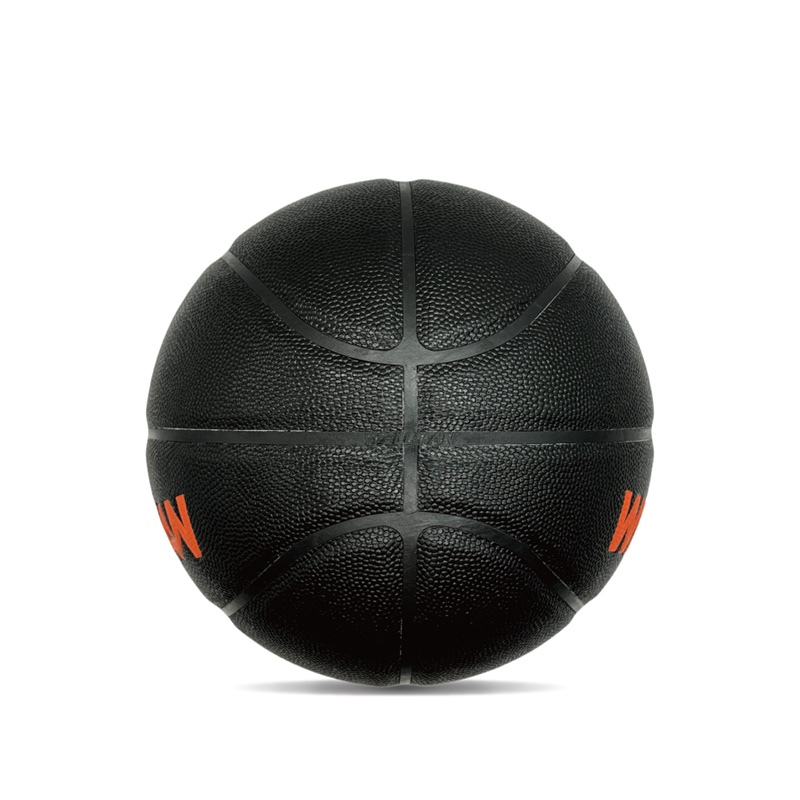 Durable Composite PU Leather Training BasketballSize 7 composite PU basketball for training and games, with moisture-absorbing grip and OEM/ODM options; worth reviewing for club programs and long-term heavy use.View Product →
Care Routines That Extend Gym Life
Indoor balls age on a predictable curve, and four habits flatten it: wipe, inflate, store and rotate. None of them cost money, and together they add months to a competition ball.
- Wipe after every session so sweat and floor dust do not cure into the pebbling.
- Check pressure weekly with a gauge rather than by hand, and top up in small increments.
- Rotate three or four balls through training so no single ball absorbs all the wear.
- Store at room temperature and moderate humidity, away from hooks, edges and sunlight.
A rotation of four balls used evenly usually outlasts two balls used constantly, even though the total purchase cost is higher upfront and the replacement cycle is easier to plan.
Frequently Asked Questions
Can an indoor basketball be used outdoors?
It can, but the soft cover glazes and wears quickly on concrete or asphalt. Expect a noticeably shorter life and a slicker surface within a few weeks of regular outdoor play.
Which indoor cover works best for schools?
Composite PU suits PE classes that rotate dozens of balls through daily use, while microfiber leather is the better fit for school teams that play competitive fixtures and need consistent grip.
How much weight variation is normal inside one order?
A tolerance of 10 to 15 g is realistic for a controlled production line. Anything wider shows up as an inconsistent feel between balls, and it should be raised with the supplier before the batch ships.
How often should an indoor game ball be replaced?
A competition ball used three or four sessions a week typically holds match-level grip for one to two seasons. Training balls should be replaced on grip loss rather than on appearance, since a clean-looking ball can still be glazed.