


 English
 русский
 Español
 Deutsch
 عربى
عربى 中文简体
中文简体
As the countdown to the 2026 FIFA World Cup in Canada, the United States and Mexico begins, the global football equipment market is undergoing a significant structural upgrade. With the tournament expanded to 48 teams and reaching an unprecedented scale, it has directly driven a sharp year-on-year increase in football product orders. Meanwhile, industry competition has shifted from simple price competition to core competition focused on manufacturing processes and performance. The differentiated value of machine sewing technology and thermal bonding technology has become increasingly prominent.
1. Process Differentiation: Two Technologies Meet Diverse Market Needs
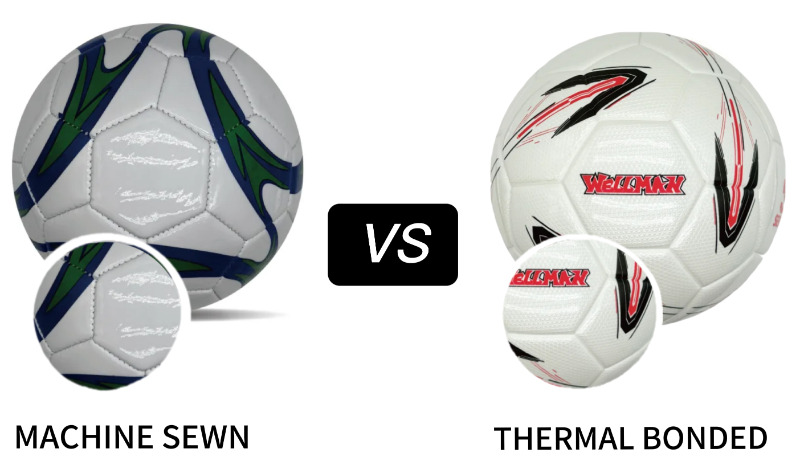
The football manufacturing industry has formed a clear market pattern: thermal bonding dominates the high-end segment, while machine sewing secures the mass market. With their unique strengths, the two processes serve professional competition and daily recreation scenarios respectively.
-
- Thermal bonding technology adopts high-temperature and high-pressure lamination to seamlessly combine panels without stitching. The finished ball features a nearly perfect round shape with a roundness error within 0.5mm, delivering extremely stable flight performance. It resists deformation under strong impacts, offers excellent water resistance, and maintains accurate passing and shooting performance after long-term use. It is the first choice for professional matches and high-level training, and all FIFA official match balls adopt this advanced process.
- As a classic traditional craft, machine sewing mass-produces footballs with mechanical stitching. Its core advantages are cost-effectiveness and affordable pricing, fully meeting the needs of daily entertainment, campus use and entry-level training. With continuous process upgrades, high-end sewn balls are coated with waterproof glue on stitching areas, greatly improving durability. Relying on high market adaptability, machine-sewn footballs still maintain the mainstream share of the mass consumer market.
2. Market Upgrade: World Cup Boosts Technical Value and Consumer Demand
The surging demand driven by the World Cup has accelerated technological differentiation and product iteration in the industry. Statistics show that the global football equipment market scale will continue to expand in 2026. As a core production base for global sports goods, China has achieved a substantial year-on-year growth in export orders, and overseas buyers have raised higher requirements for ball craftsmanship and performance.
For professional competition scenarios, thermal bonded footballs stand out with stable flight, outstanding water resistance and long service life, gaining continuous premium advantages. For mass consumers, cost-effective machine-sewn footballs are widely used for daily training and casual games, becoming an essential product for the popularization of grassroots football worldwide.
Industry insiders stated that 2026 to 2030 will be a golden period for technological upgrading in the football industry. Manufacturers with mature thermal bonding technology and optimized machine sewing craftsmanship will take the leading position in global competition. In addition, eco-friendly materials and flexible production will be the common upgrading directions for both processes, promoting the sound development of the industry with high-end quality and cost-effective products.
3. Conclusion
The 2026 World Cup is not only a global football carnival, but also a key watershed for football manufacturing technology. Machine sewing and thermal bonding are not mutually exclusive, but complementary and coordinated. They jointly promote the structural upgrading of the industry. In the future, focusing on craft innovation and meeting segmented market demands will help sports goods enterprises seize World Cup dividends and achieve long-term stable development.