


 English
 русский
 Español
 Deutsch
 عربى
عربى 中文简体
中文简体
Content
A basketball is only as good as the way it performs on the court, and one of the most fundamental aspects of its performance is inflation. A Leather Basketball that is underinflated or overinflated can significantly affect your dribbling, shooting, and passing, and may even shorten the ball’s lifespan. Understanding how to determine whether your Leather Basketball is fully inflated is essential for both casual players and serious athletes.
Why Proper Inflation Matters
Proper inflation ensures that the Leather Basketball behaves as intended. When a basketball is correctly inflated:
- Bounce consistency improves: A properly inflated ball rebounds predictably off the floor, backboard, or rim.
- Handling and grip are optimal: Overinflation can make the ball hard and slippery, while underinflation makes it soft and harder to control.
- Durability increases: Leather Basketballs can warp or crack if consistently overinflated or too soft.
- Safety is maintained: An incorrectly inflated ball can cause injury during aggressive play.
Leather Basketballs, in particular, are sensitive to inflation because genuine leather is less forgiving than synthetic materials. Too much air can stretch the leather, and too little can cause uneven wear or damage the internal bladder.
Recommended Inflation Pressure
Most Leather Basketballs have a recommended pressure range printed on or near the ball’s valve. This is usually measured in pounds per square inch (PSI), and it generally ranges from 7.5 to 8.5 PSI for a standard size 7 men’s basketball. Here’s why following this range matters:
- Consistency: Proper PSI ensures every bounce behaves as expected.
- Performance: Shooting and dribbling are much more accurate when the ball is at the right pressure.
- Longevity: Maintaining correct pressure reduces stress on seams and the leather surface.
Methods to Tell if a Leather Basketball Is Fully Inflated
There are several practical ways to determine whether your Leather Basketball is fully inflated. Combining multiple methods provides the most reliable assessment.
1. The Bounce Test
The bounce test is one of the simplest methods:
- Hold the ball at chest height.
- Drop it onto a hard surface.
- Observe the rebound height: a fully inflated Leather Basketball should bounce back to about waist level.
Tips:
- Conduct the test on a hard floor, such as a gym court. Soft surfaces like carpet will give inaccurate results.
- Avoid relying solely on this method, as leather’s stiffness can slightly affect bounce.
2. The Squeeze Test
Leather Basketballs have a firm but slightly pliable surface. The squeeze test can help you feel if it is properly inflated:
- Hold the ball with both hands.
- Press your fingers into the leather panels.
Indicators:
- Properly inflated: The ball yields slightly but feels firm.
- Underinflated: The ball is too soft, and fingers sink in easily.
- Overinflated: The ball feels rock-hard with little to no give.
3. Visual Inspection
Sometimes, underinflation or overinflation can be detected visually:
- Underinflated ball: The leather panels may appear slightly wrinkled or loose.
- Overinflated ball: The ball looks tight and may bulge near seams.
Checking for symmetry is also useful—an uneven shape indicates irregular inflation.
4. Using a Pressure Gauge
For the most accurate result, use a ball pressure gauge:
- Insert the gauge into the valve carefully.
- Read the PSI.
- Compare it with the manufacturer’s recommended range.
This method eliminates guesswork and is especially recommended for Leather Basketballs used in competitive play.
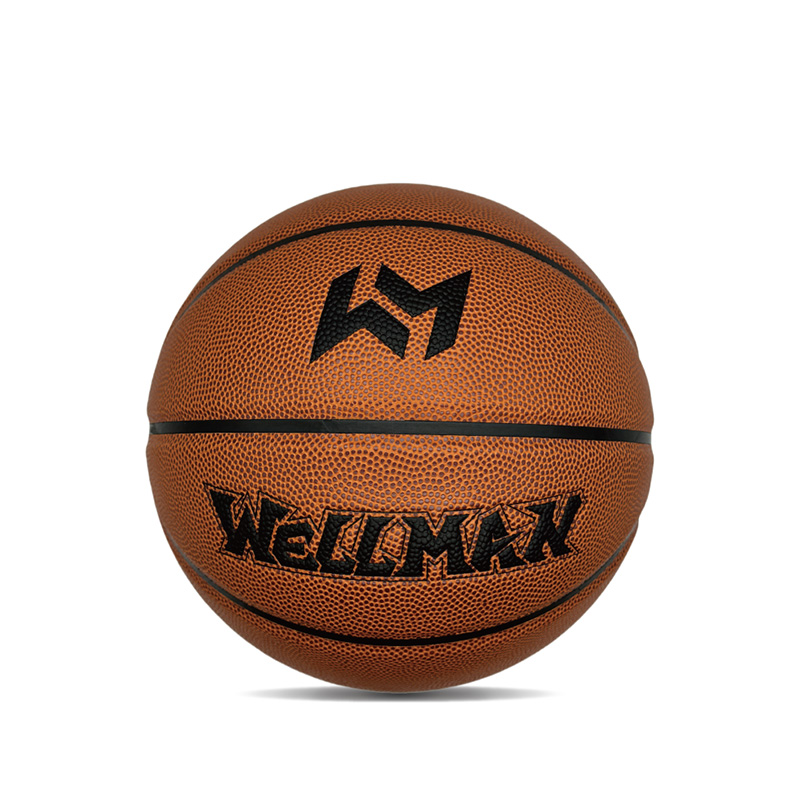
How to Inflate a Leather Basketball Properly
Proper inflation requires the right tools and technique:
- Use a quality pump with a needle: Always lubricate the needle with water or glycerin to avoid damaging the valve.
- Check PSI frequently: Inflate gradually and check with a gauge.
- Avoid over-pumping: Leather stretches over time, so slightly under the maximum recommended PSI is usually safer.
Maintenance Tips for Leather Basketballs
Even a fully inflated Leather Basketball can degrade without proper care. Here are some tips:
- Keep it dry: Water can damage leather. Wipe off any moisture immediately.
- Store in a cool place: Avoid extreme heat or sunlight, which can dry out the leather.
- Condition occasionally: Use leather conditioners specifically made for sports balls to maintain suppleness.
- Rotate usage: Regularly changing the orientation of the ball helps maintain its shape.
Common Mistakes to Avoid
- Ignoring the valve instructions: Forcing a pump needle without lubrication can puncture the bladder.
- Relying only on bounce or squeeze tests: While helpful, these methods are not always precise.
- Using outdoor courts exclusively: Leather Basketballs are intended primarily for indoor use; using them outdoors can compromise inflation and durability.
Conclusion
Knowing how to tell if a Leather Basketball is fully inflated is crucial for performance, durability, and safety. While simple tests like bouncing and squeezing provide quick checks, using a pressure gauge remains the most reliable method. Coupled with proper inflation techniques and maintenance, a Leather Basketball can perform optimally for years. By paying attention to inflation and overall care, you ensure that every shot, pass, and dribble feels consistent and enjoyable on the court.